Physical Address
Islamabad, Pakistan
Physical Address
Islamabad, Pakistan

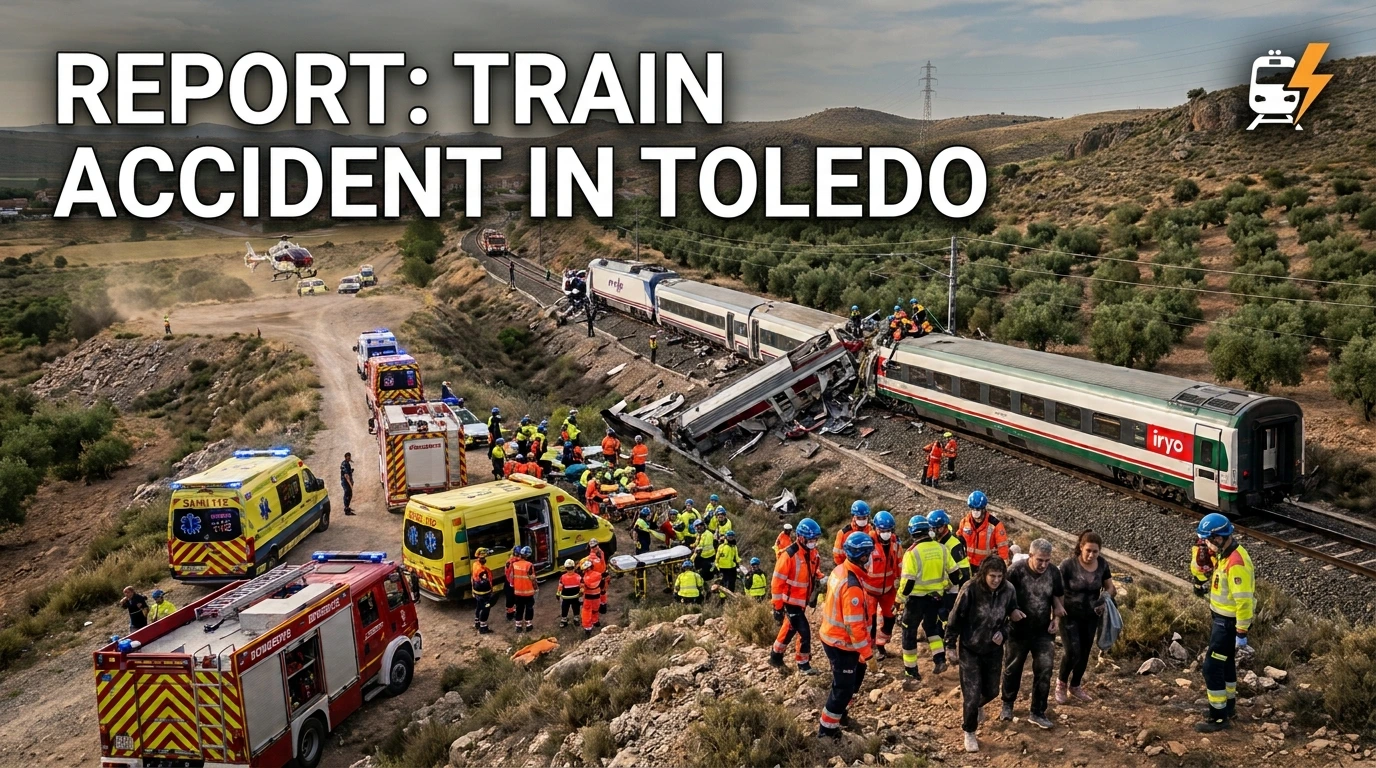
High-speed rail travel has long been celebrated as the gold standard of European transit—a seamless, efficient, and exceptionally safe alternative to air travel. That sense of safety was shattered this week when a devastating collision occurred between two high-speed trains near Toledo on the Madrid-Seville line in central Spain.
As the country enters three days of national mourning, investigators, authorities, and the public are left grappling with a central question: How could a system built around automated, multi-layered safety fail so catastrophically?
On Wednesday morning, a computer malfunction disrupted the automated signalling system across a 63-kilometer (39-mile) stretch of track between Madrid and Andalusia. As designed under safety protocols, trains in the affected sector came to a complete halt. Among them was a train operated by the private rail service Iryo, carrying 147 passengers.
Minutes later, a state-operated Renfe AVE train—carrying 397 passengers—was instructed by the central rail control command in Madrid to resume its journey.
Crucially, the instruction was given to proceed under normal operating conditions (“con marcha normal”) rather than at a reduced safety speed, despite a stop signal technically remaining active on the line. The Renfe train accelerated, colliding into the rear of the stationary Iryo train at speeds estimated up to 200 km/h (124 mph).
“Suddenly, everything started falling apart. Bang! … There was blood all over.”
— Samy Paul, passenger aboard the RENFE train
The impact destroyed the rear carriages of the Iryo train and the front of the Renfe train, derailing multiple cars and scattering wreckage along the gravel slopes of Toledo’s olive fields.
Emergency medical services, military brigades, and local residents rushed to the scene. Local construction workers who heard the crash cut through safety barriers to help survivors escape through broken windows using emergency first-aid kits.
| Incident Summary | Key Details |
| Location | Urda, Toledo Province (Castile-La Mancha) |
| Trains Involved | Renfe AVE 2080 & Iryo 6076 |
| Total Passengers | 544 total (397 Renfe / 147 Iryo) |
| Fatalities | 69 confirmed victims |
| Injuries | Over 80 injured (15+ critical) |
Spanish Prime Minister Pedro Sánchez declared three days of national mourning, while European leaders expressed condolences as emergency teams worked continuously to clear the wreckage.
In modern high-speed rail networks, safety is governed by Automatic Train Protection (ATP) systems and European Rail Traffic Management Systems (ERTMS). These systems are engineered to prevent human error by automatically applying brakes if a train approaches another vehicle or exceeds speed thresholds.
The tragedy highlights a critical vulnerability in complex transit systems: the interaction between automated failure modes and human override protocols.
Transport Minister Óscar Puente described the control center’s order as an “inexplicable decision,” confirming that audio recordings between dispatch and the train driver are central to the official investigation.
This disaster marks the second fatal high-speed collision in Spain this year, forcing an immediate review of high-speed protocols across the Iberian peninsula and the broader European Union.
Investigators are currently focusing on:
As families mourn and the investigation unfolds, the tragedy serves as a solemn reminder that even the world’s most advanced transit networks remain reliant on the human decisions guiding them behind the scenes.