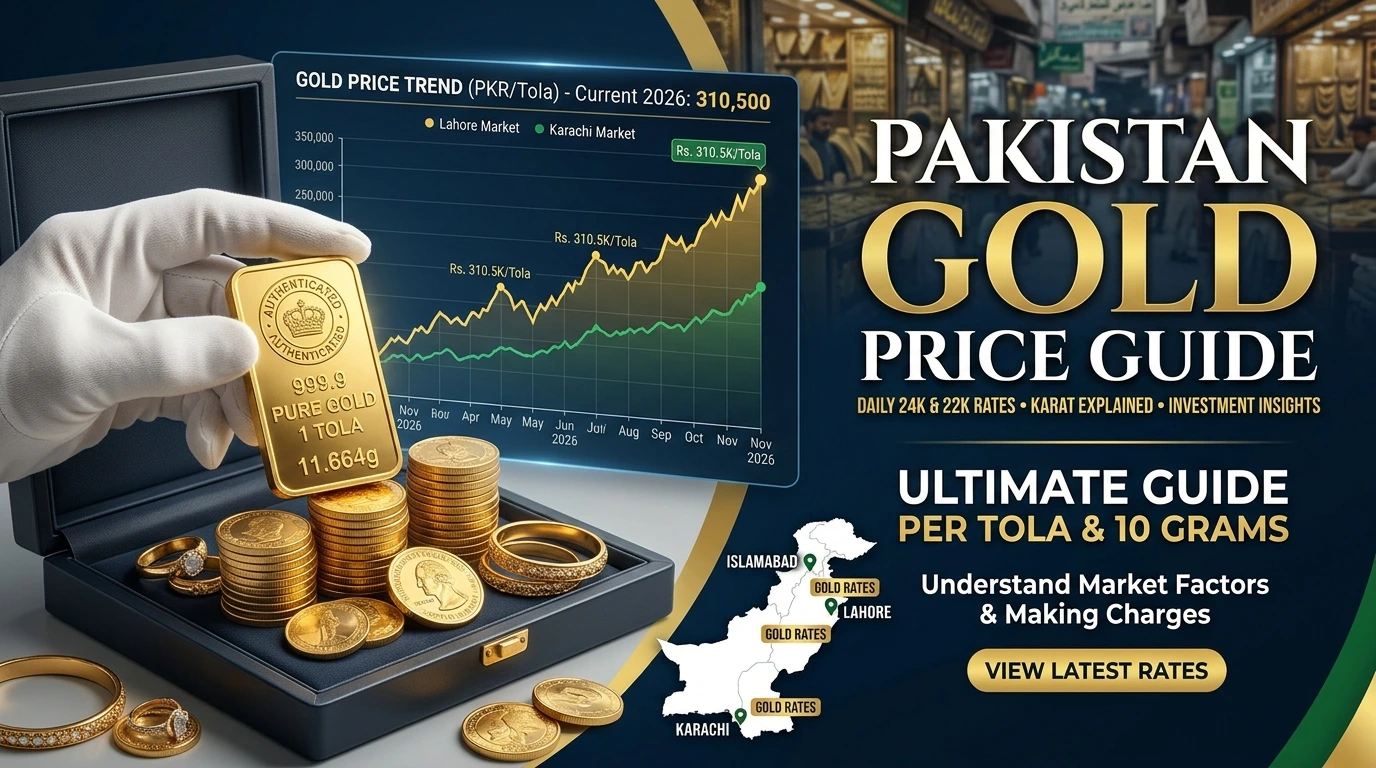
Gold holds a central place in Pakistan’s culture and economy. Whether as a traditional gift for weddings, a hedge against inflation, or a safe-haven asset, it remains one of the most trusted ways to store wealth.
Understanding gold pricing in Pakistan—measured primarily in tolas—can feel complex due to shifting exchange rates, international spot market movements, and differences in purity.
1. What is a “Tola”? Understanding Gold Units in Pakistan
While global gold markets trade in troy ounces ($31.1035\text{ grams}$), Pakistan uses the traditional South Asian system of measurement:
1 Tola = $11.664\text{ grams}$
1 Tola = $12\text{ Mashas}$ = $96\text{ Rattis}$
10 Grams = $0.857\text{ Tolas}$
When checking local markets or news announcements from the All Pakistan Gems and Jewellers Sarafa Association (APGJSA) or regional Sarafa boards (e.g., Karachi, Lahore, Rawalpindi/Islamabad), rates are always quoted per tola alongside 10-gram pricing.
2. Gold Purity Breakdown: 24K vs. 22K vs. 21K
Not all gold is created equal. The price per tola varies significantly based on karat (purity):
24 Karat (99.9% Pure): Known as Rawa or pure bullion gold. It is used for gold bars, coins, and raw investment bullion. It is too soft for detailed jewelry making.
22 Karat (91.6% Pure): Mixed with small amounts of copper or silver for strength. This is the international standard for durable gold jewelry.
21 Karat (87.5% Pure): The most common standard for traditional Pakistani jewelry crafted in localSarafa markets.
18 Karat (75.0% Pure): Contains 75% pure gold, often used for modern, lightweight, or stone-studded designer jewelry.
Gold prices in Pakistan do not move in isolation. They are determined by a combination of global and domestic macroeconomic factors:
International Spot Gold Price (XAU/USD): Global gold is priced in US Dollars per troy ounce. When central banks adjust interest rates, or when global economic uncertainty rises, international spot prices move, directly impacting domestic rates.
Pakistani Rupee (PKR) Exchange Rate: Because Pakistan imports gold, local rates depend heavily on the USD/PKR exchange rate. Even if global gold prices remain stable, a depreciating Rupee drives up the local price per tola.
Local Sarafa Board Premiums & Demand: Regional Sarafa associations adjust daily physical supply-and-demand premiums, accounting for seasonal spikes such as wedding seasons (Shaadi season) or Eid festivals.
4. How to Calculate the Price of Gold Jewelry
When buying gold jewelry, the final cost is higher than the raw rate per tola due to additional charges.
$$\text{Final Price} = (\text{Weight in Tolas} \times \text{Karat Rate per Tola}) + \text{Making Charges} + \text{Wastage} + \text{Taxes}$$
Making Charges (Katai / Mazdoori): The jeweler’s crafting fee, ranging from 5% to over 20% depending on the complexity of the design.
Wastage (Khad): The gold lost during melting and crafting. Always clarify the exact wastage percentage with your jeweler before finalizing a purchase.
5. Physical Gold vs. Digital Alternatives in Pakistan
If you are buying gold as an investment rather than for personal wear, consider the following formats:
TT-Bars & Raw Gold (Rawa): Available in 1-tola, 5-tola, and 10-tola cast bars. These carry minimal making charges and offer the highest liquidity when selling back to Sarafa markets.
Gold Coins / Minted Biscuits: Standardized weights issued by certified refiners (e.g., 1g, 5g, 10g, or 1 tola). Easy to trade, though they carry small minting/packaging fees.
Digital & Commodity Contracts: Traded on platforms like the Pakistan Mercantile Exchange (PMEX) for investors who want gold exposure without physical storage risks.
Final Thoughts
Gold remains one of Pakistan’s premier tangible assets for protecting purchasing power against inflation and currency devaluation. However, navigating the gold market requires diligence:
Always verify the karat count and request a stamped invoice stating purity, net gold weight, and itemized making charges.
Track both global spot prices and local exchange rates to understand market trends before making large purchases.
Prioritize pure 24K bars or coins over jewelry if your primary goal is wealth preservation or capital growth, as jewelry incurs non-refundable labor and wastage costs upon resale.