Physical Address
Islamabad, Pakistan
Physical Address
Islamabad, Pakistan

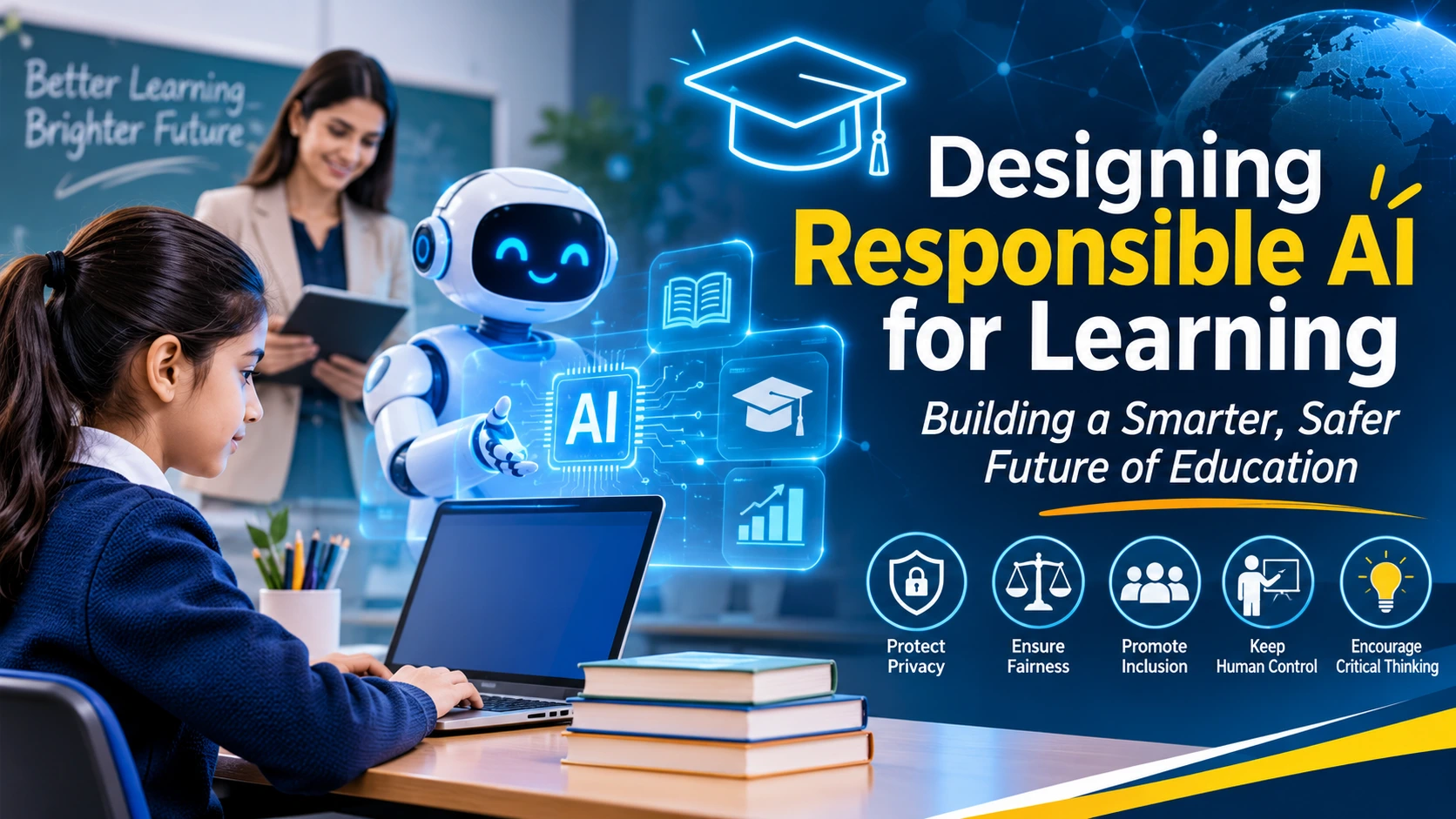
Artificial Intelligence (AI) is transforming the education sector by changing how students learn, how teachers teach, and how educational institutions operate. From personalized learning platforms to AI-powered tutors, technology is making education more accessible, interactive, and efficient. However, as AI becomes increasingly integrated into classrooms, designing responsible AI for learning has become more important than ever.
Responsible AI is not just about developing advanced technology. It is about ensuring that AI systems are fair, transparent, safe, inclusive, and beneficial for everyone involved in education.
Responsible AI for learning refers to the development and use of artificial intelligence tools that support education while respecting human values, privacy, fairness, and academic integrity.
These systems should help students understand difficult concepts, assist teachers in managing classrooms, and provide personalized educational experiences without replacing human judgment.
The main goal is to make AI a supportive learning partner rather than a substitute for teachers or independent thinking.
Student information must be protected when developing AI-powered educational platforms. These systems may collect personal information, learning activities, academic records, and performance data.
Responsible AI developers should:
Protecting student privacy helps build trust between learners, teachers, parents, and educational institutions.
One of the biggest challenges in AI development is algorithmic bias. If an AI system is trained using limited or biased information, it may produce unfair results for certain groups of students.
Responsible AI should provide equal learning opportunities regardless of a student’s gender, location, language, disability, or financial background.
Educational AI platforms should also support different languages and learning abilities so that students from underserved communities can benefit from technological advancements.
AI should assist teachers rather than replace them. Teachers understand students’ emotional needs, learning difficulties, and personal circumstances in ways that automated systems cannot fully understand.
For example, AI can suggest personalized study plans, identify knowledge gaps, and provide practice exercises. However, teachers should remain responsible for important educational decisions.
Human supervision is especially important when AI is used for grading, student evaluation, and academic recommendations.
Students and teachers should understand when they are interacting with AI and how its recommendations are generated.
Educational platforms should clearly communicate:
AI systems can sometimes generate inaccurate information. Therefore, users should be encouraged to verify important facts rather than accepting every AI-generated answer.
Responsible AI should encourage students to think independently instead of simply providing answers to every question.
For example, an AI tutor can explain a mathematics problem step by step, offer hints, and encourage students to solve similar problems independently.
This approach helps learners develop problem-solving abilities, creativity, analytical thinking, and confidence.
The objective should be to make students better thinkers, not simply faster users of technology.
Teachers play a central role in the successful adoption of responsible AI in education. They need proper training to understand AI technologies, identify potential risks, and integrate digital tools into their teaching methods.
Schools and universities should organize AI training programs that help educators:
When teachers understand AI, they can guide students toward using technology productively and ethically.
Although AI offers exciting opportunities, implementing it responsibly comes with several challenges.
Data privacy concerns: Educational platforms must prevent unauthorized access to sensitive student information.
Digital inequality: Students without reliable internet access or modern devices may not receive the same benefits as others.
Academic dishonesty: Some students may depend on AI to complete assignments without understanding the subject.
Incorrect information: AI systems can produce misleading answers, making human verification essential.
Lack of AI awareness: Teachers, students, and parents may not have sufficient knowledge about responsible AI practices.
Addressing these challenges requires cooperation between technology developers, governments, educational institutions, teachers, and parents.
When designed responsibly, AI can create new opportunities for students and educational institutions.
Some important applications include:
According to the OECD’s 2026 Digital Education Outlook, generative AI can improve learning when it is guided by clear educational principles rather than simply being used to complete tasks.
Governments and educational organizations must establish clear policies to ensure AI technologies are developed and used ethically.
These policies should focus on student safety, data protection, fairness, transparency, teacher training, and human accountability.
International organizations such as UNESCO and the OECD emphasize human-centred approaches to AI, ensuring that technology strengthens educational opportunities without weakening human decision-making.
Designing responsible AI for learning is essential for building a smarter, safer, and more inclusive educational future. Artificial intelligence has the potential to transform traditional education by providing personalized learning experiences, supporting teachers, and making educational resources more accessible.
However, technological progress must go hand in hand with ethical responsibility. Protecting student privacy, preventing discrimination, promoting independent thinking, and maintaining human oversight should remain the foundations of AI-powered education.
The future of education should not be about replacing human intelligence with artificial intelligence. Instead, it should be about bringing humans and technology together to create better learning opportunities for everyone.
Responsible AI is not just the future of education; it is the foundation of education we can trust.