Physical Address
Islamabad, Pakistan
Physical Address
Islamabad, Pakistan

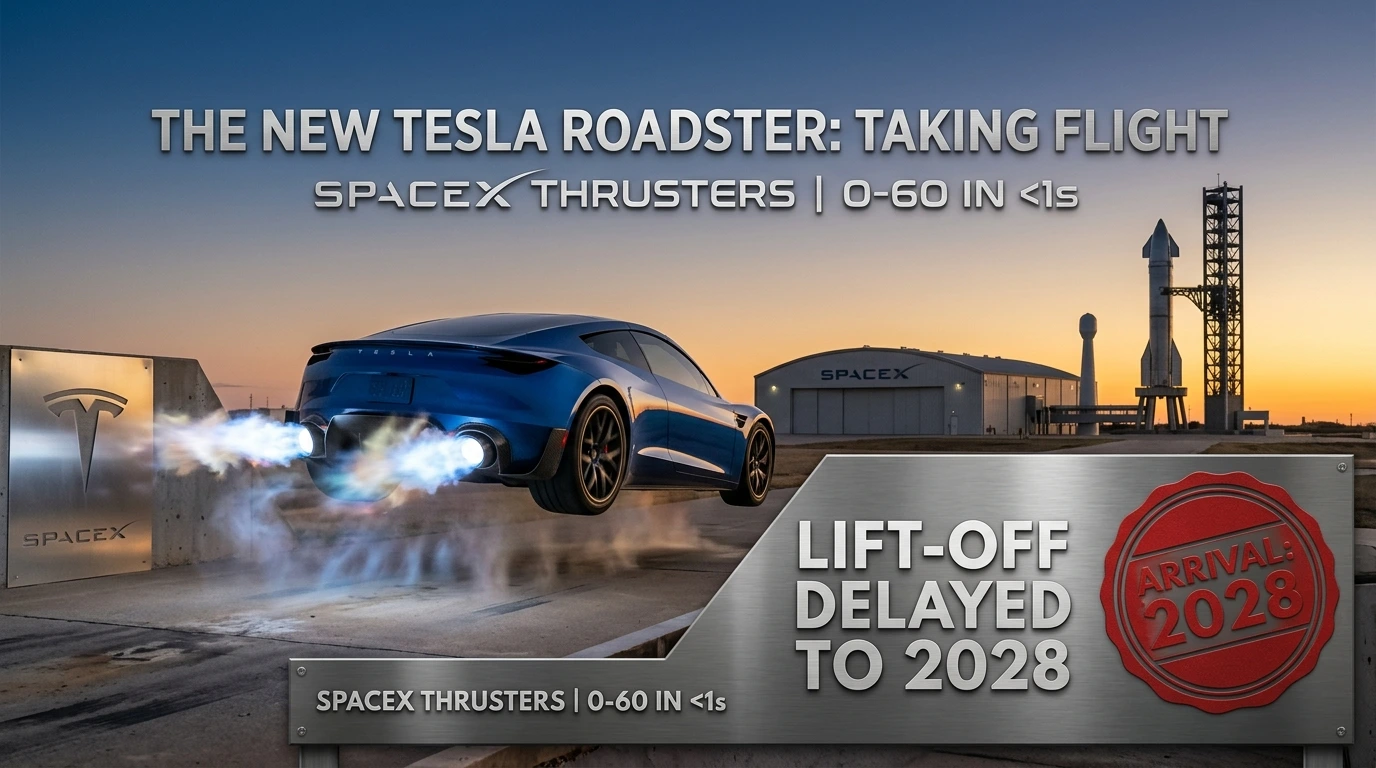
It is official: Tesla has taken the hypercar wars to literal new heights. At a dramatic reveal event at SpaceX’s rocket-testing facility in McGregor, Texas, Elon Musk unveiled a redesigned prototype of the long-delayed Tesla Roadster 2.0—and it did what no production-adjacent car has ever done.
Equipped with cold-gas thrusters powered by SpaceX aerospace technology, the supercar quite literally airborne-pivoted in mid-air and maneuvered over a line of parked vehicles before landing back on solid ground.
Yet, true to form for one of the most delayed projects in automotive history, there is a catch: you won’t actually be able to buy or drive one until at least 2028.
When Tesla first teased the “SpaceX Package” for the Roadster back in 2018, many industry observers dismissed cold-gas thrusters as pure internet bravado or a PR stunt.
During the live demonstration, the engineering behind the madness was laid bare:
“This is not necessarily a safety-optimized car, OK? But it takes the fun meter to 11 out of 10.”— Elon Musk
First announced in November 2017 with an original target release of 2020, the second-generation Roadster has been pushed back repeatedly.Early reservation holders who put down massive deposits almost a decade ago have weathered year after year of schedule slips.
So why is production now pegged for 2028?
Tesla’s updated order page details three distinct tiers for the Roadster line:
| Variant | Key Feature | Highlight Spec | Road Legal? |
| Standard Roadster | Suction system & active aero | Max track downforce | Yes |
| SpaceX Package (Limited) | Rear cold-gas thrusters | 0–60 mph in <1.0 second | Track/Controlled Only |
| Air-Ready / Flying Edition | Perimeter thrusters + 1-seat layout | Mid-air rotational flight | 🚫 No (Off-Road / Closed Airspace) |
The recent demonstration proves that the engineering works in a tightly controlled test environment.Seeing a sleek white-and-titanium supercar float, turn in mid-air, and set down with rocket precision is undeniably breathtaking.
However, until production lines actually roll out customer deliveries in 2028, skepticism will remain high.For now, the new Roadster exists in a strange limbo: part electric hypercar, part experimental rocket craft, and completely ungrounded until late this decade.
What do you think? Is a hover-capable electric hypercar worth waiting over a decade for, or should Tesla stick to standard high-performance EVs? Let us know in the comments below!