Physical Address
Islamabad, Pakistan
Physical Address
Islamabad, Pakistan

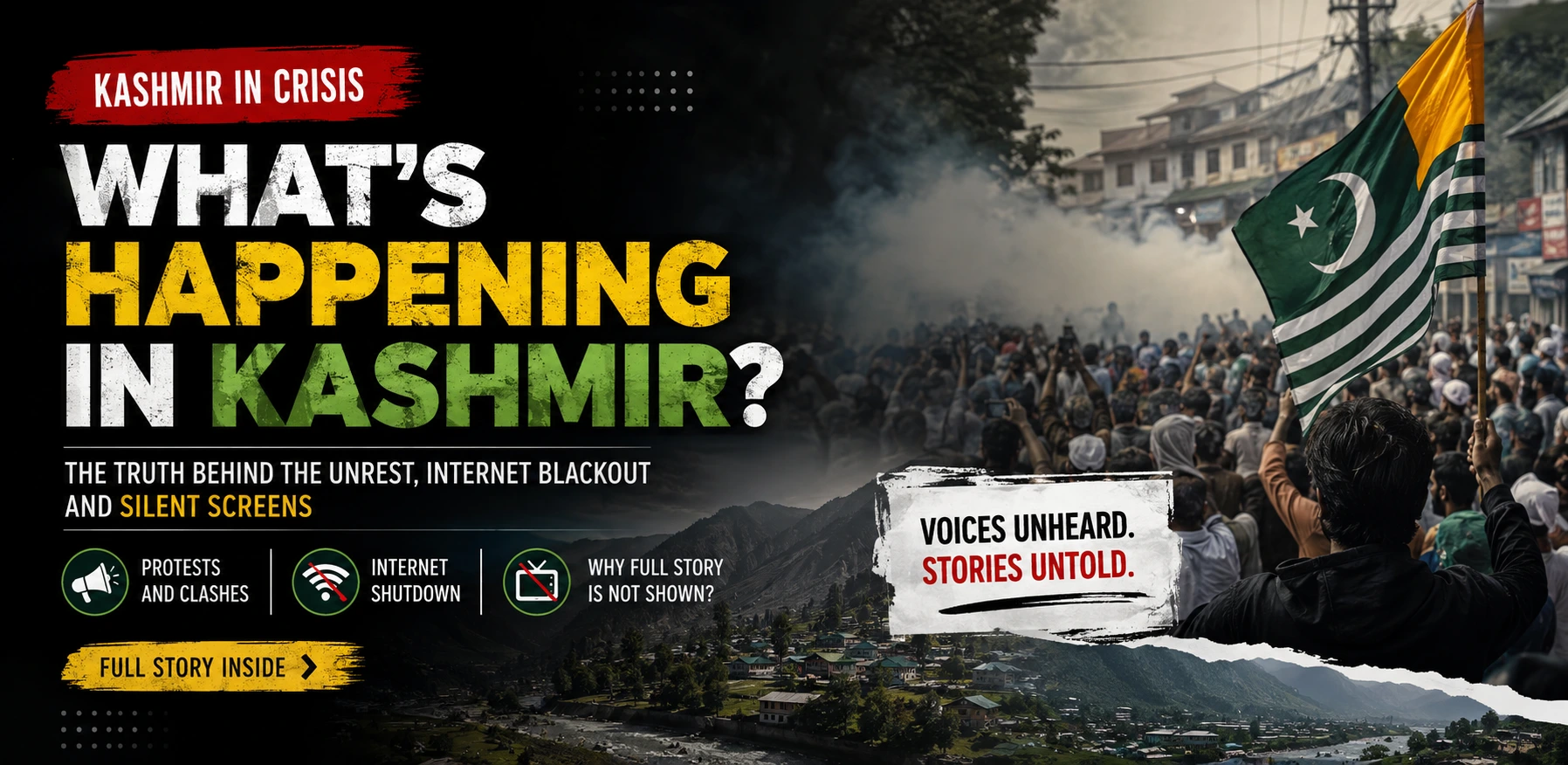
A serious political and social crisis has been unfolding in Azad Jammu & Kashmir (AJK), but many people outside the region may not have seen the full extent of what has happened.
In recent weeks, protests, clashes, election disputes, deaths, road closures and communication restrictions have created an increasingly tense situation. The crisis has also affected the region’s elections, with voting postponed in several constituencies because of security concerns.
The situation is particularly sensitive because Kashmir is already at the centre of the long-running dispute between Pakistan and India. As a result, developments inside Pakistan-administered Kashmir can quickly become politically controversial.
So what exactly is happening, and why does it sometimes appear that only part of the story is being reported?
The latest unrest is closely connected to political representation, elections and demands from local activists.
The Joint Awami Action Committee (JAAC), a protest movement that has been at the centre of the unrest, has challenged the political system in AJK, particularly the 12 legislative seats reserved for people who migrated from Indian-administered Kashmir.
Protesters argue that these seats can give political influence to people who do not currently live in AJK. The authorities, however, reject the protesters’ accusations and have described some elements involved in the unrest as violent or linked to outside interests.
The disagreement became particularly serious during the 2026 AJK elections.
The protests have not remained peaceful everywhere.
Reports from July described deadly clashes between protesters and security personnel. The numbers reported by different sides have differed considerably.
The JAAC and other sources have reported dozens of deaths, while government officials have disputed some of the casualty figures and blamed armed or militant elements for violence. Reuters reported that protesters claimed more than 30 people had died in Rawalakot, while authorities disputed the account.
Amnesty International also reported allegations that security forces used lethal force against protesters and called for an investigation, while noting that casualty accounts differed between protesters, media and authorities.
This difference in accounts is important: not every casualty figure circulating on social media can be independently verified, and readers should be careful about treating one side’s numbers as established fact.
The unrest directly affected the AJK elections.
The elections were conducted in stages, but voting in seven constituencies was postponed because of security concerns following deadly clashes and unrest. Road closures and an internet blackout also complicated the election process.
The political contest has also been controversial.
Pakistan’s ruling PML-N has emerged as the strongest party in the election, while the opposition PTI boycotted the vote, citing concerns about alleged electoral irregularities. The PPP has also made allegations of electoral fraud, which PML-N has rejected.
This means Kashmir’s political crisis is not simply about one protest. It is connected to a much wider debate about representation, elections and Islamabad’s relationship with AJK.
This is one of the most important questions surrounding the crisis.
One major reason is restricted communication and access to the region.
Amnesty International reported that mobile internet services in Jammu & Kashmir had remained suspended since June 5. Such restrictions make it much harder for residents to upload videos, communicate with journalists or independently document events.
International media access has also reportedly faced restrictions. The Guardian reported that new rules restricted where foreign journalists could report, while other reports described journalists being prevented from freely covering events in Kashmir.
When journalists cannot easily reach affected areas and residents cannot reliably communicate online, the public receives a much smaller amount of independently verified information.
There are serious concerns about media freedom surrounding the Kashmir unrest.
The Guardian reported that Pakistani authorities introduced restrictions affecting international media shortly after deadly protests. The restrictions have made independent reporting more difficult.
At the same time, it would be too simplistic to say that nothing is being reported.
Major international organizations including Reuters, AP, Al Jazeera and Amnesty International have covered the protests, election disruption and communications restrictions.
The bigger issue is that the amount and speed of information coming from the region can be limited, particularly when communications are disrupted and journalists face restrictions.
Kashmir has been disputed between India and Pakistan since 1947.
Because both countries have competing claims over the wider Kashmir region, almost every major development there carries political significance.
For Pakistan, Kashmir has enormous political and national importance. For India, developments in Pakistan-administered Kashmir are also closely watched and frequently used in political and diplomatic arguments.
This creates another problem for ordinary readers: information about Kashmir can quickly become part of a Pakistan-versus-India narrative.
That makes it especially important for readers to distinguish between:
When television coverage is limited, people naturally turn to social media.
Videos from residents can sometimes show events that mainstream media cannot immediately reach. However, social media also creates serious problems.
Old videos can be presented as new.
Videos from completely different locations can be incorrectly labelled as Kashmir.
Casualty figures can be exaggerated.
Political groups can selectively publish material supporting their own narrative.
For this reason, a viral video should not automatically be treated as proof.
The safest approach is to compare several independent sources before accepting a major claim.
The protest movement has focused on political representation and broader grievances.
One major dispute concerns the 12 reserved refugee seats in the AJK Legislative Assembly. Protesters argue that the system gives disproportionate political influence to people who are not residents of the region.
The controversy is therefore not simply an anti-government protest. It involves deeper questions about how AJK’s political system works and how much influence local residents should have over their own government.
The authorities have rejected accusations that the entire protest movement represents peaceful political dissent.
Government officials have argued that some elements of the movement became violent and have accused militants or outside forces of exploiting the unrest. Pakistan’s information minister, Attaullah Tarar, has described elements within the banned JAAC movement as pursuing what the government characterizes as a foreign agenda.
These are government allegations, not independently established facts, and should be presented as such.
The protesters, meanwhile, have accused authorities of excessive force and restrictions on their movement and communications.
The biggest problem is the lack of one universally accepted account.
There are competing narratives:
Government narrative:
Violence was encouraged by militant or outside elements and security forces were responding to unrest.
Protesters’ narrative:
People were demonstrating over political rights and reforms, and authorities used excessive force against them.
Independent reporting:
Journalists and rights organizations have documented serious violence and communications restrictions but have also noted conflicting casualty figures and allegations from both sides.
This is why responsible reporting should avoid declaring unverified claims to be facts.
The immediate focus is on completing the disrupted election process and dealing with the political consequences of the unrest.
Voting in some constituencies has already been delayed, while re-polling has also been ordered at several polling stations.
But the election alone is unlikely to solve the deeper problems.
The next AJK government will have to deal with questions about political representation, public trust, relations with Islamabad, the treatment of protesters and the credibility of the electoral process.
The situation in Azad Kashmir deserves attention—not because every dramatic claim circulating online is necessarily true, but because the combination of deadly unrest, election disputes, communication restrictions and limited media access makes independent reporting particularly important.
People outside Kashmir should not have to depend solely on government statements, opposition claims or viral social-media posts.
The best way to understand what is happening is to compare multiple credible sources, identify what has been independently verified and clearly separate confirmed information from allegations.
Kashmir’s people deserve to have their voices heard, and the public deserves accurate information about what is happening there.
The story is bigger than a political fight. It is about transparency, representation, freedom of information and the right of people to know what is happening in their own region.