Physical Address
Islamabad, Pakistan
Physical Address
Islamabad, Pakistan

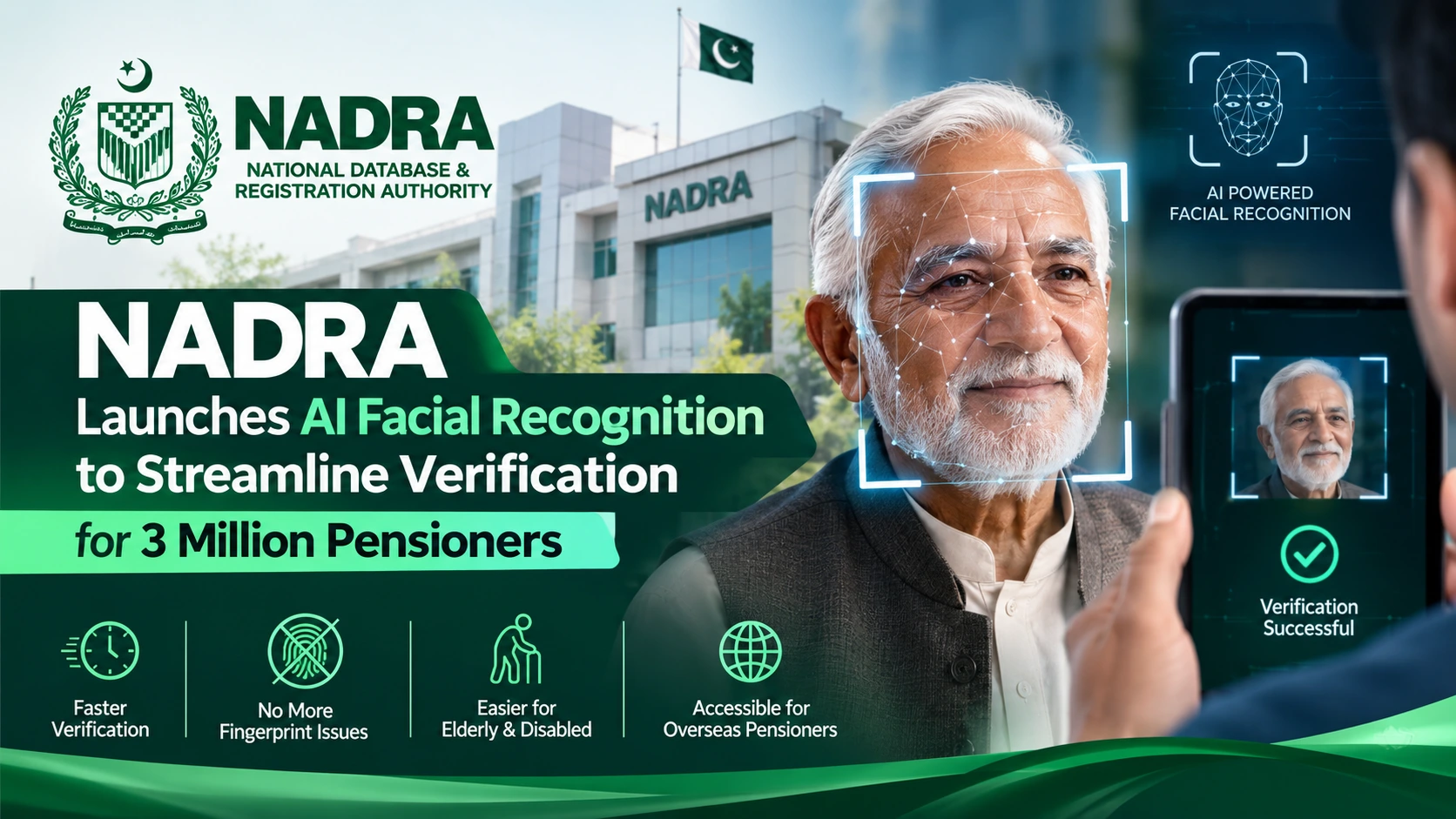
Pakistan’s National Database and Registration Authority (NADRA) has introduced an AI-powered facial recognition system aimed at making pension verification easier, faster and more accessible for millions of retirees across the country.
The new National Pensioners Verification System (NPVS) is designed to simplify the traditional “proof of life” process, particularly for elderly pensioners who often face difficulties with fingerprint-based biometric verification.
According to the latest announcement, the system will benefit more than three million pensioners belonging to federal and provincial departments, the armed forces and autonomous institutions.
The system was formally launched by Prime Minister Shehbaz Sharif on August 20, 2026, and has now been activated for pension verification.
Instead of requiring pensioners to repeatedly visit banks or government offices for physical verification, the new system allows their identity and proof of life to be confirmed digitally.
The AI-based system uses facial recognition as an alternative to traditional fingerprint authentication.
This is particularly important for senior citizens because fingerprints can become difficult to scan with age. Worn fingerprints, medical conditions and other factors can result in failed biometric verification.
After successful facial verification, an electronic Proof-of-Life Certificate is generated automatically. The certificate is then transmitted to the relevant pension authorities through the digital system.
One of the biggest advantages of the new system is the reduction in physical paperwork and visits to banks.
Previously, pensioners could face considerable inconvenience when they were required to physically appear for verification. The digital approach aims to replace this process with automated verification, saving time and reducing the burden on elderly citizens.
NADRA has also described the NPVS as a free service, making it more accessible to pensioners who may otherwise struggle with additional verification costs.
The initiative could be especially useful for elderly and disabled pensioners.
NADRA has been expanding its multi-biometric verification capabilities to provide alternatives when fingerprints cannot be successfully captured. Its current verification framework includes facial recognition alongside other biometric technologies.
This approach could make government services more inclusive by reducing dependence on a single biometric method.
Another important feature is support for pensioners living outside Pakistan.
Overseas Pakistani retirees can use the digital verification system to confirm their status remotely, potentially eliminating the need for complicated additional procedures or travel solely for proof-of-life requirements.
This could be particularly valuable for retired Pakistanis living abroad who continue to receive pensions from Pakistani institutions.
The facial-recognition initiative is part of NADRA’s broader move toward digital identity and biometric services.
NADRA has already expanded its identity verification infrastructure through platforms such as Nishan Pakistan, which provides authorised organisations with access to services including facial and fingerprint matching, demographic verification and Proof-of-Life APIs.
The authority also provides biometric verification services through its digital ecosystem, including the PakID application. NADRA says its verification infrastructure has already processed hundreds of millions of biometric verifications.
The introduction of AI-powered facial recognition represents another step toward reducing paperwork and making public services more citizen-friendly.
For pensioners, the most important benefit could be convenience: fewer physical visits, less paperwork and a faster way to prove that they are alive and eligible to continue receiving their pension.
At the same time, the growing use of facial recognition makes data security, privacy and responsible biometric use increasingly important. NADRA says its verification ecosystem incorporates measures including data-minimisation requirements, security protocols and purpose-based access to identity information.
NADRA’s latest initiative demonstrates how artificial intelligence and biometric technology are increasingly becoming part of Pakistan’s public-service infrastructure.
If successfully expanded, facial recognition could eventually make other identity-dependent services easier for citizens who cannot use conventional fingerprint verification.
For millions of pensioners, however, the immediate goal is much simpler: making proof-of-life verification faster, easier and less stressful.
With the National Pensioners Verification System now operational, Pakistan is taking another significant step toward replacing traditional paperwork-heavy processes with digital identity services.