Physical Address
Islamabad, Pakistan
Physical Address
Islamabad, Pakistan

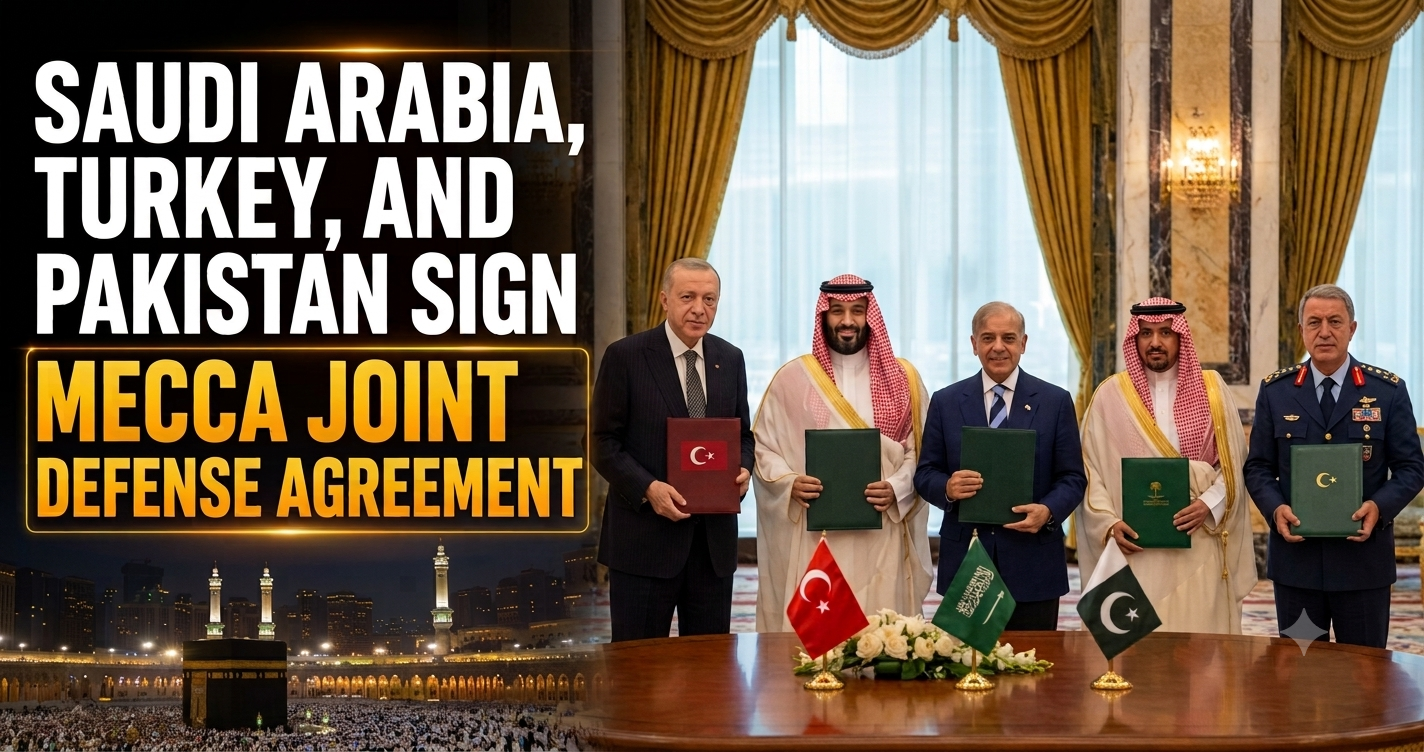
A major new development has emerged in the Middle East and South Asia after Saudi Arabia, Türkiye and Pakistan signed a joint defence agreement in Makkah on August 7, 2026. The agreement, known as the Makkah Joint Defence Agreement, represents a significant step toward closer security and military cooperation among the three countries.
The agreement comes at a time of heightened regional tensions and growing concerns about security, energy routes and military escalation across the Middle East. Under the pact, the three countries have agreed that an armed attack against any one of them will be regarded as an attack against all three.
The agreement has attracted international attention because of the strategic importance of all three countries and their existing military and political relationships.
The Makkah Joint Defence Agreement is designed to strengthen collective deterrence, defence cooperation and coordination between Saudi Arabia, Türkiye and Pakistan.
The central principle is simple: an armed attack against one of the three countries will be considered an attack against all three.
This provision has drawn comparisons with the collective-defence principle in NATO’s Article 5. However, Turkish Foreign Minister Hakan Fidan said the agreement is a regional security arrangement and is not directed against Iran or any other specific country.
The agreement also does not publicly specify exactly what military response each country would be required to provide in the event of an attack. Reuters reported that the joint statement did not lay out detailed military commitments or specify the exact form of assistance.
The agreement was signed on August 7, 2026, in Makkah, Saudi Arabia.
The location is particularly significant because Makkah is the holiest city in Islam and carries enormous religious and symbolic importance for Muslims around the world.
The signing brought together the leadership of three influential Muslim-majority countries and highlighted their intention to deepen strategic cooperation at a time of major regional uncertainty.
The pact is important because Saudi Arabia, Türkiye and Pakistan each bring different strategic capabilities to the partnership.
Saudi Arabia is one of the most economically and strategically important countries in the Middle East. It is also a major global energy producer and has been investing heavily in modernizing its armed forces.
The kingdom has faced growing security concerns linked to regional conflicts, missile attacks and threats to energy infrastructure and shipping routes.
The new agreement gives Saudi Arabia an additional regional security framework involving two countries with significant military capabilities.
Türkiye is a major regional military power and a member of NATO.
It has developed a substantial domestic defence industry, particularly in areas such as drones, missiles, armored vehicles and other military technologies.
Türkiye also maintains close defence relationships with both Pakistan and Saudi Arabia. Its participation therefore adds another important military and technological dimension to the new partnership.
Pakistan brings one of the region’s largest and most experienced armed forces to the arrangement.
The country has historically maintained close military ties with Saudi Arabia, including defence training, military personnel cooperation and operational coordination.
Pakistan and Saudi Arabia already signed a Strategic Mutual Defense Agreement in September 2025, which stated that aggression against either country would be considered aggression against both.
The 2026 Makkah agreement expands the security framework to include Türkiye.
The new agreement should not be viewed as completely separate from the security relationship that Pakistan and Saudi Arabia have already developed.
In September 2025, Pakistan and Saudi Arabia signed their bilateral Strategic Mutual Defense Agreement. The agreement aimed to strengthen defence cooperation and joint deterrence against aggression.
The Makkah agreement brings Türkiye into a three-country framework, potentially creating a broader network for security cooperation.
This makes the new pact strategically important because it connects Pakistan’s military capabilities, Türkiye’s defence industry and NATO experience, and Saudi Arabia’s financial and strategic weight.
The agreement represents a significant defence partnership, but it is important not to overstate what has been publicly announced.
The three countries have described the arrangement in terms of collective deterrence and defence cooperation. Publicly available details do not establish a NATO-style command structure or specify automatic military intervention in every possible conflict.
Turkish Foreign Minister Hakan Fidan said the agreement is technically comparable to the mutual-defence concept associated with NATO Article 5, while also emphasizing that it is not aimed at a particular country.
Therefore, the exact military mechanisms will become clearer as the countries establish the institutions and procedures required under the agreement.
An important part of the agreement’s future development will be the creation of mechanisms to coordinate the partnership.
According to Reuters, the three countries plan to establish a ministerial committee and a secretariat in Saudi Arabia. More operational details are expected to be discussed through the committee’s meetings.
This could eventually lead to greater coordination in areas such as:
However, the exact scope of these activities will depend on future decisions by the three governments.
The agreement comes during a period of serious instability in the wider Middle East.
Regional tensions have increased significantly, with Iran, Gulf countries, Israel, the United States and armed groups in the region involved in a rapidly changing security environment.
Saudi Arabia has faced security concerns involving missile and drone threats, while regional fighting has also affected energy supplies and maritime trade.
The agreement therefore reflects a broader trend toward regional countries developing their own security arrangements rather than relying entirely on external powers. Reuters reported that the pact comes amid concerns over regional instability and changing calculations about foreign security support.
Iran has also responded to the new development.
On August 10, 2026, Iranian Foreign Ministry spokesman Esmaeil Baghaei said Tehran saw no reason to be concerned about the Pakistan–Türkiye–Saudi security pact.
He described the development as part of a regional move toward greater self-reliance in security and said such cooperation could be positive if it remains inclusive and addresses genuine regional security concerns.
This response is important because Iran is one of the major regional powers whose security calculations could be affected by closer military cooperation between Saudi Arabia, Türkiye and Pakistan.
The agreement has also attracted attention in South Asia, particularly because of Pakistan’s longstanding tensions with India.
However, the countries involved have publicly emphasized that the pact is defensive and not directed against a particular state.
It would therefore be premature to assume that the agreement automatically means Saudi Arabia or Türkiye would enter any future Pakistan-India conflict.
The practical response of each country would depend on the circumstances, the nature of an attack and the mechanisms eventually established under the agreement.
Another interesting development is the possibility of the partnership expanding.
Turkish Foreign Minister Hakan Fidan said that Turkish President Recep Tayyip Erdoğan wants to see the arrangement expand, with Egypt mentioned as a potential future participant.
This is significant because Egypt is already part of the broader consultation framework involving Türkiye, Pakistan and Saudi Arabia.
In June 2026, Türkiye, Egypt, Pakistan and Saudi Arabia held their fourth consultative foreign ministers’ meeting in Cairo. The four countries emphasized continued consultation and coordination on peace, security and stability in the region.
If the defence arrangement eventually expands, it could create a much larger regional security network.
The three countries’ new defence agreement also builds on existing diplomatic cooperation.
Türkiye, Saudi Arabia and Pakistan have been working with Egypt through a consultation mechanism often referred to as the R4.
In April 2026, senior officials from the four countries met in Islamabad, following an earlier foreign ministers’ consultation.
In June, the four foreign ministers met again in Cairo and discussed regional and international developments.
This existing diplomatic structure may provide a foundation for broader cooperation beyond defence.
Pakistan and Saudi Arabia already have a long history of military cooperation.
In April 2026, Saudi Arabia announced that a Pakistani military force, including fighter and support aircraft, had arrived at King Abdulaziz Air Base under the countries’ Strategic Mutual Defense Agreement.
Saudi authorities said the deployment was intended to strengthen military coordination and operational readiness and support regional security and stability.
This shows that the new trilateral agreement follows years of practical defence cooperation rather than creating an entirely new relationship overnight.
Türkiye’s defence industry could become an important component of the new cooperation.
Türkiye has become increasingly prominent in international defence markets, particularly through its development and export of unmanned aerial systems and other military technologies.
Saudi Arabia has also sought to develop its domestic defence capabilities and diversify its military partnerships.
Greater cooperation between the two countries could therefore lead to increased technology cooperation, defence production and training.
Saudi Arabia and Türkiye also signed a separate agreement in February 2026 aimed at cooperation on renewable-energy power projects, demonstrating that their relationship extends beyond defence.
Although the Makkah agreement is primarily focused on defence, its broader implications could extend into economics and energy security.
Saudi Arabia is one of the world’s most important energy producers, while Pakistan and Türkiye are major regional economies and important transportation and trade hubs.
Regional instability can affect:
The three countries have previously emphasized the importance of regional stability and secure trade routes.
Pakistan has also played a diplomatic role in efforts to reduce tensions involving the United States and Iran. In June 2026, Pakistan helped facilitate the Islamabad Memorandum of Understanding between Washington and Tehran, with Saudi Arabia and Türkiye among the countries involved in the broader diplomatic effort.
The next stage will be particularly important.
The agreement establishes the political framework, but its long-term importance will depend on how the three countries implement it.
Possible developments could include:
The creation of the ministerial committee and Saudi-based secretariat will likely provide greater clarity on these issues.
The agreement has the potential to influence the regional balance of power, but its ultimate impact will depend on implementation.
The three countries collectively possess considerable military, economic and diplomatic resources. Pakistan has nuclear weapons and a large military; Türkiye has NATO membership and an increasingly capable defence industry; and Saudi Arabia has substantial financial resources and major strategic importance in the Gulf.
However, the pact does not automatically create a unified military force.
Its real significance will become clearer if the three countries move from political declarations toward regular joint exercises, integrated planning, intelligence sharing and coordinated defence capabilities.
The Saudi Arabia–Türkiye–Pakistan Makkah Joint Defence Agreement is one of the most significant regional security developments of 2026.
Signed in Makkah on August 7, the agreement establishes the principle that an armed attack against one of the three countries will be regarded as an attack against all three.
For Pakistan, it strengthens an already close strategic relationship with Saudi Arabia while adding Türkiye to a broader defence framework.
For Saudi Arabia, it creates another layer of regional security cooperation at a time when Gulf security and energy infrastructure face serious risks.
For Türkiye, it expands its strategic role in the Middle East while deepening its existing relationships with Pakistan and Saudi Arabia.
The biggest question now is not whether the agreement is historically significant—it clearly is—but how the three countries will turn the agreement into practical military cooperation.
As the planned ministerial committee and secretariat begin their work, the coming months could reveal whether the Makkah pact becomes a limited defence partnership or the foundation of a much broader regional security arrangement.