Physical Address
Islamabad, Pakistan
Physical Address
Islamabad, Pakistan

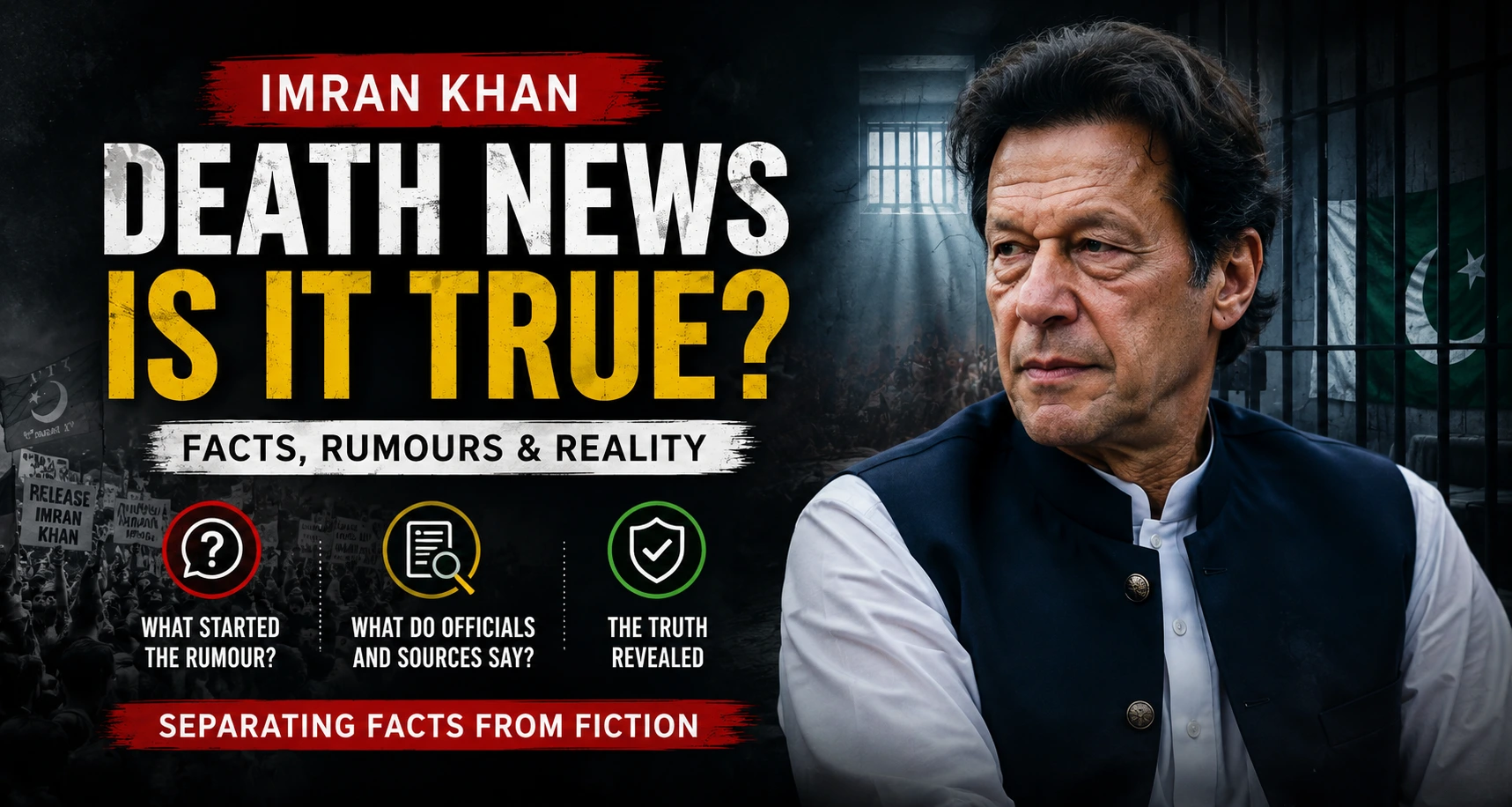
A fresh wave of rumours about the death of former Pakistani Prime Minister and PTI founder Imran Khan has spread across social media and news platforms, creating anxiety among millions of his supporters.
But is Imran Khan actually dead?
At the time of writing, there is no credible, independently verified evidence confirming that Imran Khan has died. Pakistan’s military has rejected the death rumours, while the journalist who originally made the alarming claim later clarified that his information was not a confirmed report.
The situation has nevertheless raised serious questions about Imran Khan’s health, access to him in prison and why information about his condition has become so difficult to verify.
The latest controversy began after Pakistani journalist Wajahat Saeed Khan published videos discussing Imran Khan’s condition in Adiala Jail.
According to reports, the journalist claimed that three senior military sources had expressed fears that Imran Khan might no longer be alive.
The claim immediately spread across social media, with many users treating the allegation as confirmed news.
However, there was an important problem:
The claim was never independently verified.
The journalist subsequently walked back the certainty of his original claim and said it should not be treated as confirmation of Imran Khan’s death.
The rumours became so widespread that Pakistan’s military publicly responded.
According to multiple reports, the military rejected the claim that Imran Khan had died in custody and described the reporting as false.
This is significant because official confirmation of the death of a former prime minister would normally be a major national event.
At present, there has been no publicly verified death announcement supported by independent evidence.
Therefore, headlines stating simply “Imran Khan Is Dead” would be misleading based on the information currently available.
The rumours did not appear in a vacuum.
Imran Khan has been imprisoned at Adiala Jail in Rawalpindi since 2023, and questions about his health and access to him have repeatedly generated concern.
Recent reports say his family, lawyers and supporters have faced difficulties obtaining regular access or information about his condition.
That lack of direct information has created an environment in which rumours can spread extremely quickly.
When people cannot independently verify whether a public figure is healthy, sick or receiving medical treatment, even an unverified social-media post can create nationwide panic.
There are several reasons.
Imran Khan is currently in prison, meaning ordinary supporters cannot see him directly.
Information about his condition therefore depends largely on prison authorities, lawyers, family members and official statements.
Imran Khan remains one of Pakistan’s most influential and controversial political figures.
Because his supporters and opponents have sharply different views about his political situation, rumours involving him can quickly become politically charged.
Platforms such as X, Facebook, TikTok and YouTube can spread breaking claims within minutes.
The problem is that speed does not equal accuracy.
A claim can be viewed by millions of people before journalists have enough time to verify it.
No.
There has been no credible family confirmation that Imran Khan has died.
Previous death rumours involving Khan have also circulated while he was in prison. In one earlier episode, his sister was allowed to meet him at Adiala Jail and said he was alive.
The latest reports should therefore be distinguished from confirmed information.
Pakistan Tehreek-e-Insaf (PTI) has expressed serious concern about reports regarding Imran Khan’s wellbeing.
The party has demanded access to its founder and has argued that uncertainty surrounding his condition is causing anxiety among supporters.
Reports have also described preparations for large political mobilisation if access to Khan remains restricted.
However, PTI’s concerns should not automatically be interpreted as confirmation that Imran Khan has died.
This is a separate question from whether he is dead.
There have been continuing reports and allegations about Imran Khan’s health while in prison.
Some reports have discussed concerns involving his eyesight and blood pressure, while his family and supporters have repeatedly requested better access to him and medical information.
But individual claims about his medical condition also need to be independently verified.
Being concerned about someone’s health is not the same as having evidence that the person has died.
The central issue is the lack of easily verifiable, independent information.
There are currently several different narratives:
The death-rumour narrative:
A journalist claimed that sources feared Khan may have died in custody.
The official narrative:
Pakistan’s military rejected the death report as false.
The PTI narrative:
The party says uncertainty surrounding Khan’s health and restricted access are causing serious concern.
The independent verification problem:
There is currently no publicly available, independently verified evidence establishing that Imran Khan has died.
This distinction is extremely important.
As of August 14, 2026, the latest reporting indicates that the death claim remains unverified, while Pakistan’s military has publicly rejected the rumour. The journalist who triggered the latest wave of speculation also backed away from presenting his claim as confirmed fact.
Therefore, readers should not share posts saying “Imran Khan has died” as established fact.
The more accurate headline at this stage is:
“Imran Khan Death Rumours Spread Online as Authorities Reject Claims”
Death rumours involving a major political leader can have serious consequences.
They can cause:
This is why news organizations should verify such claims before publishing them as facts.
Social-media users also have a responsibility.
Before sharing a post claiming that Imran Khan has died, ask:
Who reported it?
Is the source credible?
Has the claim been independently verified?
Has Khan’s family confirmed it?
Have multiple reliable news organizations confirmed it?
If the answer is no, the claim should be treated as a rumour—not as breaking news.
The latest Imran Khan death story has created enormous speculation in Pakistan, but there is currently no verified evidence that Imran Khan has died.
The original allegation came from an unverified report, the journalist subsequently clarified his position, and Pakistan’s military rejected the death claim.
The bigger story is therefore not simply “Is Imran Khan dead?”
It is also about why information about his condition is so difficult to independently verify and why a lack of access can allow rumours to become national news within hours.
Until credible, independently verified evidence emerges, the responsible conclusion is: