Physical Address
Islamabad, Pakistan
Physical Address
Islamabad, Pakistan

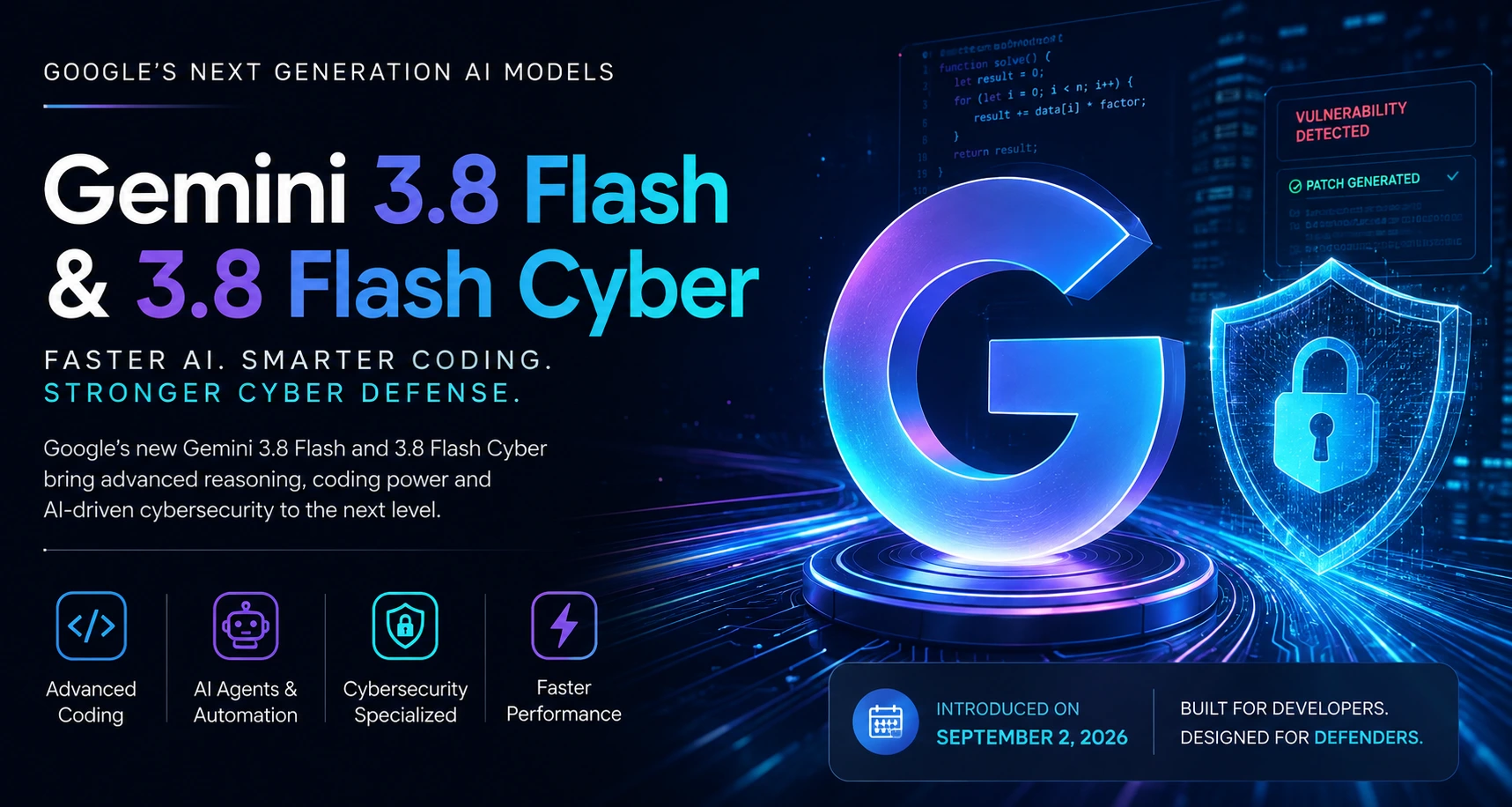
Google has introduced Gemini 3.8 Flash and Gemini 3.8 Flash Cyber, two new artificial intelligence models designed to improve advanced reasoning, software development, autonomous AI agents, and cybersecurity.
Announced on September 2, 2026, the release comes only a few weeks after Gemini 3.7 Flash and represents another major step in Google’s rapidly evolving Gemini lineup. Google describes Gemini 3.8 as its strongest Flash-series model yet for reasoning and coding.
Gemini 3.8 Flash is designed as a fast, cost-efficient general-purpose AI workhorse. Rather than focusing only on answering questions, Google has optimized the model for complex tasks that require planning, reasoning, coding and repeated interaction with external tools.
One of the biggest changes is that Gemini 3.8 Flash can “work harder” on difficult problems by taking additional reasoning steps and making iterative tool calls. This can allow it to tackle longer and more complicated tasks than previous Flash models.
Software engineering is one of the major areas where Google says Gemini 3.8 Flash has improved.
The model has been tested on long-horizon software engineering tasks, where an AI must understand a problem, write code, test it and continue making corrections until the task is completed.
Google says Gemini 3.8 Flash outperforms many larger frontier models on the DeepSWE v1.1 benchmark while maintaining the speed and lower-cost positioning of the Flash family.
This could make the model particularly useful for:
Another important focus is agentic AI.
Instead of simply responding to a single prompt, an AI agent can break a complicated objective into multiple steps, use tools, evaluate its progress and continue working toward the final result.
Google says Gemini 3.8 Flash has been designed specifically for these long-running workflows. Demonstrations include building interactive games, creating software projects and generating complex visual applications from relatively simple instructions.
This could make AI assistants increasingly useful for tasks that previously required significant human involvement.
Alongside the standard model, Google introduced Gemini 3.8 Flash Cyber, a specialized version focused specifically on cybersecurity.
Unlike the regular Flash model, Cyber is designed to help trusted defenders identify vulnerabilities and fix them.
Google says the model focuses on two major areas:
Vulnerability discovery: Finding weaknesses in software and codebases.
Automated patching: Developing fixes that can address discovered vulnerabilities.
The model is currently being made available through Google’s Fairwind Program to trusted defenders, including government authorities, critical infrastructure operators and software maintainers.
Gemini 3.8 Flash Cyber has produced impressive results in Google’s testing.
On the CyberGym vulnerability-discovery benchmark, Google DeepMind reports a Pass@1 score of 86.2%, placing the model ahead of several other models evaluated in the same comparison.
Google also says its internal testing across complex codebases covering 20 programming languages produced a vulnerability-discovery success rate above 70%.
The company says Gemini 3.8 Flash Cyber has already been used to help secure Google’s own code. According to Google, the Chrome security team found that it generated substantially more correct vulnerability patches than larger commercial models in its testing.
| Feature | Gemini 3.8 Flash | Gemini 3.8 Flash Cyber |
|---|---|---|
| Main purpose | General AI and reasoning | Cybersecurity |
| Coding | Excellent | Specialized for security code |
| AI agents | Yes | Yes |
| Vulnerability discovery | Strong | Specialized |
| Automated patching | General capability | Major focus |
| Availability | Developers, enterprises and consumers | Trusted defenders |
| Fairwind Program | No | Yes |
The two models share the same underlying intelligence, but they are optimized for different environments. Gemini 3.8 Flash is intended for broad AI applications, while Flash Cyber is aimed at professional cybersecurity defense.
Google has kept the introductory API pricing for Gemini 3.8 Flash at $0.75 per million input tokens and $3.75 per million output tokens through December 31, 2026.
Beginning January 1, 2027, Google says the price will increase to $1.50 per million input tokens and $7.50 per million output tokens.
However, there is an important consideration: because Gemini 3.8 Flash can perform additional reasoning and tool calls, some complex tasks may consume more tokens than earlier models. Therefore, the same token price does not necessarily mean every task will cost the same overall.
Google says Gemini 3.8 Flash includes safeguards designed to reduce misuse in areas including cyber offense and CBRN-related risks.
The Cyber version uses a different mitigation approach because cybersecurity defenders need broader capabilities for detecting and fixing vulnerabilities. For that reason, Google is limiting access to Gemini 3.8 Flash Cyber through the Fairwind Program rather than making it broadly available.
The release highlights an important change in the AI market: smaller and faster models are becoming increasingly capable of handling tasks that once required much larger systems.
Gemini 3.8 Flash combines relatively low-cost inference with stronger reasoning, coding and agent capabilities. That could be particularly valuable for startups, developers and businesses that need AI to perform large numbers of automated tasks.
The Cyber version also demonstrates how AI is moving beyond simple chatbots toward specialized systems capable of helping security teams analyze enormous amounts of code and identify vulnerabilities.
Gemini 3.8 Flash represents Google’s latest push to make advanced reasoning and coding available through a faster, more affordable model. Its improvements in software engineering and agentic workflows could make it a strong option for developers and businesses building AI-powered applications.
Meanwhile, Gemini 3.8 Flash Cyber takes the same underlying intelligence into a much more specialized field. Its focus on vulnerability discovery and automated patching shows how AI could become an increasingly important tool for defending software and digital infrastructure.
With Google continuing to release new Flash models at a rapid pace, Gemini 3.8 could be an important step toward a future where AI agents don’t just answer questions—they plan, code, test, discover problems and help solve them autonomously.