Physical Address
Islamabad, Pakistan
Physical Address
Islamabad, Pakistan

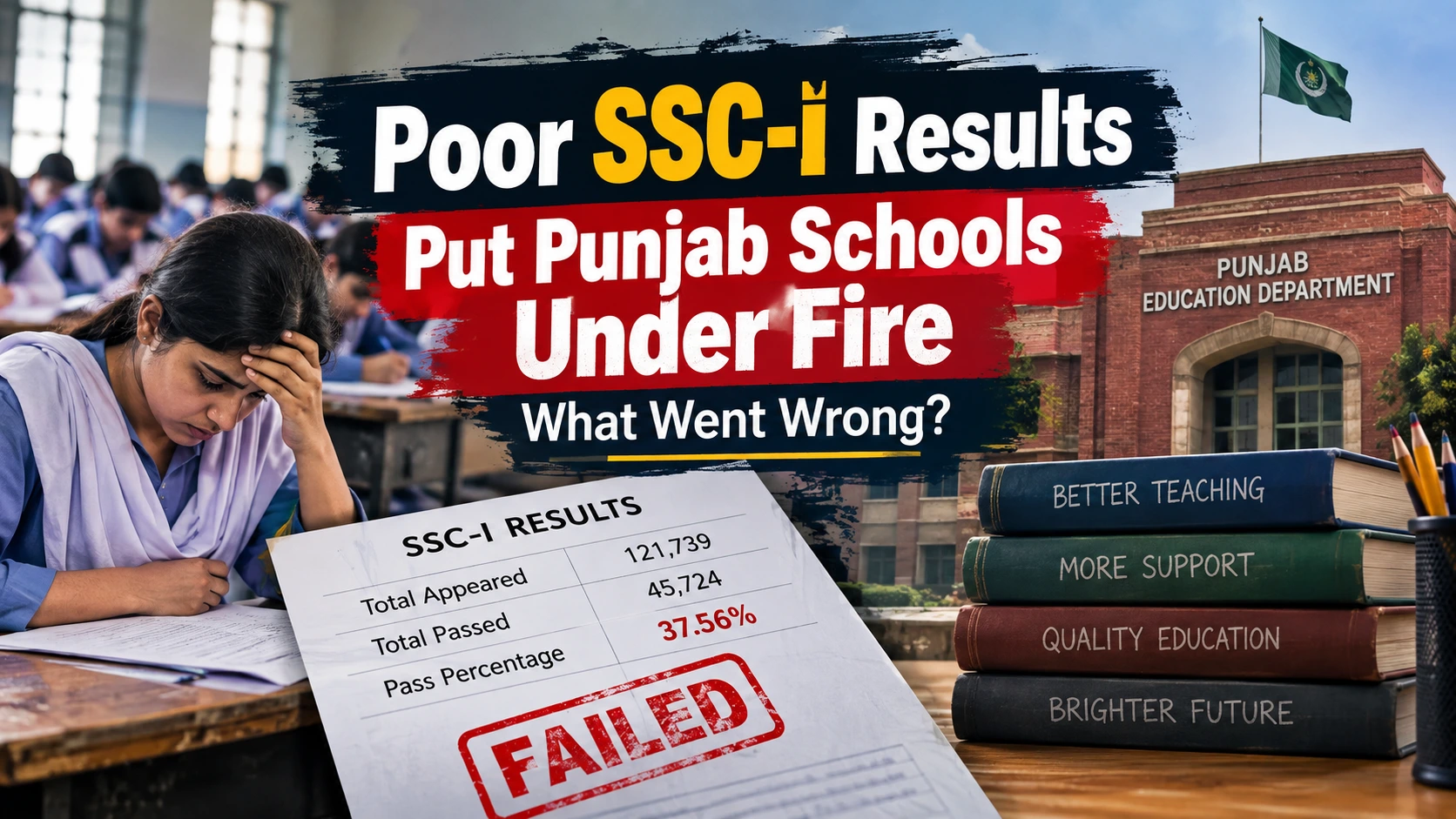
Punjab’s education system is facing renewed scrutiny after the results of the 2026 Secondary School Certificate Part-I (SSC-I), or Class 9 examinations, revealed a worrying level of underperformance across the province.
The issue has become particularly serious in Rawalpindi, where a large number of schools recorded extremely poor results, including dozens reporting a zero per cent pass rate. The disappointing figures have triggered a dispute between education authorities and teachers’ organisations over who should be held responsible.
The SSC-I results were announced across Punjab’s nine educational boards, and the overall performance has raised questions about the quality of teaching, academic planning and educational policies.
In Rawalpindi, the situation is especially concerning. According to the Rawalpindi Board, 121,739 students appeared in the Class 9 examinations, but only 45,724 were declared successful, giving an overall pass percentage of 37.56 per cent. More than 76,000 students were unsuccessful.
The figures have placed considerable pressure on schools, particularly government institutions.
One of the most alarming aspects of the results is the number of schools where no student managed to pass.
According to reports, 184 schools affiliated with the Rawalpindi Board recorded a zero per cent result, including 81 government schools.
When both public and private institutions are considered, 91 schools in Rawalpindi, 35 in Attock, 26 in Chakwal, 24 in Jhelum, 10 in Murree and eight in Talagang reportedly recorded zero per cent results.
Such figures have intensified concerns about whether students are receiving adequate academic support before appearing in board examinations.
The Punjab Education Department has reportedly started taking disciplinary measures against schools with exceptionally poor results.
Principals and headteachers of underperforming institutions are facing action, while some class teachers are reportedly being transferred and show-cause notices issued.
Approval has also reportedly been given for strict departmental action against heads and teachers of government schools where the Class 9 pass rate falls between zero and 15 per cent.
The government’s position is that teachers and school leadership must take greater responsibility for ensuring that students are properly prepared for examinations.
Teachers’ organisations, however, have strongly rejected the idea that teachers alone are responsible for the disappointing results.
Representatives have instead blamed government policies, academic disruptions and insufficient teaching time.
Teachers have pointed to the limited number of actual teaching days during the academic year. They argue that prolonged holidays, three weekly holidays and relatively short daily teaching hours have reduced classroom learning time and made it difficult for teachers to complete the curriculum effectively.
The teachers’ side has reportedly presented a 30-point charge sheet against the government and education department, arguing that systemic problems need to be addressed instead of simply punishing individual teachers.
The results have also highlighted a significant performance gap between public and private schools.
According to figures cited by the All Pakistan Private Schools & Colleges Association, government schools under BISE Rawalpindi recorded a pass rate of approximately 30.82 per cent, compared with 60.41 per cent for private affiliated schools.
A similar difference was reported under BISE Gujranwala, where public schools recorded a pass rate of 39.59 per cent, compared with 69.71 per cent in private institutions.
These figures have prompted calls for a detailed and independent performance audit of schools across Punjab.
There is unlikely to be one single explanation for the poor results. Several factors may be contributing to the problem.
Teachers say the academic calendar does not provide enough effective teaching days. Less classroom time means less opportunity to explain difficult concepts, conduct revision and identify students who need additional support.
Class 9 represents an important transition for students. Those who enter secondary school with weaknesses in mathematics, science, English or other core subjects can struggle when the curriculum becomes more demanding.
The debate has also raised questions about teacher training and professional development. Improving teachers’ access to modern teaching methods could help schools address changing curriculum and examination requirements.
Students often face enormous pressure during board examinations. A system focused heavily on memorisation rather than conceptual understanding can leave students vulnerable when examination questions require application and reasoning.
Teachers’ organisations argue that educational policies, school administration and the academic calendar must also be examined. Holding individual teachers responsible without addressing these wider issues, they say, could fail to solve the underlying problem.
While accountability is necessary, the debate must ultimately remain focused on students.
A poor result can have a major psychological impact on a teenager. Students who fail several subjects may lose confidence at a crucial stage of their education.
Authorities therefore need to ensure that disciplinary measures against schools are accompanied by academic recovery programmes, remedial classes and counselling.
The objective should not simply be to punish schools with poor results but to help those schools improve.
Education experts and stakeholders have increasingly called for practical reforms rather than temporary reactions.
Punjab could consider introducing regular diagnostic assessments, additional classes for struggling students, stronger teacher training programmes and closer monitoring of schools with consistently weak results.
An independent performance audit could also help determine whether poor results are primarily linked to teaching quality, student attendance, school management, curriculum challenges or other factors.
The All Pakistan Private Schools & Colleges Association has already called for an independent performance audit and greater involvement of private-sector stakeholders in education policy.
The 2026 SSC-I results should be viewed as more than just a set of disappointing statistics.
When hundreds of schools struggle to produce successful candidates, it points to deeper challenges within the education system. At the same time, blaming teachers alone—or schools alone—may not provide a lasting solution.
The government, teachers, school administrations, parents and students all have a role to play.
Punjab now has an opportunity to use these results as a diagnostic tool rather than simply a reason for punishment. If authorities identify the real causes and provide schools with the resources and support they need, today’s disappointing results could become the starting point for meaningful educational reform.
The real measure of success will not be how many teachers receive show-cause notices, but whether next year’s students receive better teaching, stronger academic support and a fairer opportunity to succeed.